Chargement...
Why Website Traffic Drops After a Redesign and What to Fix First
Why Website Traffic Drops After a Redesign and What to Fix First
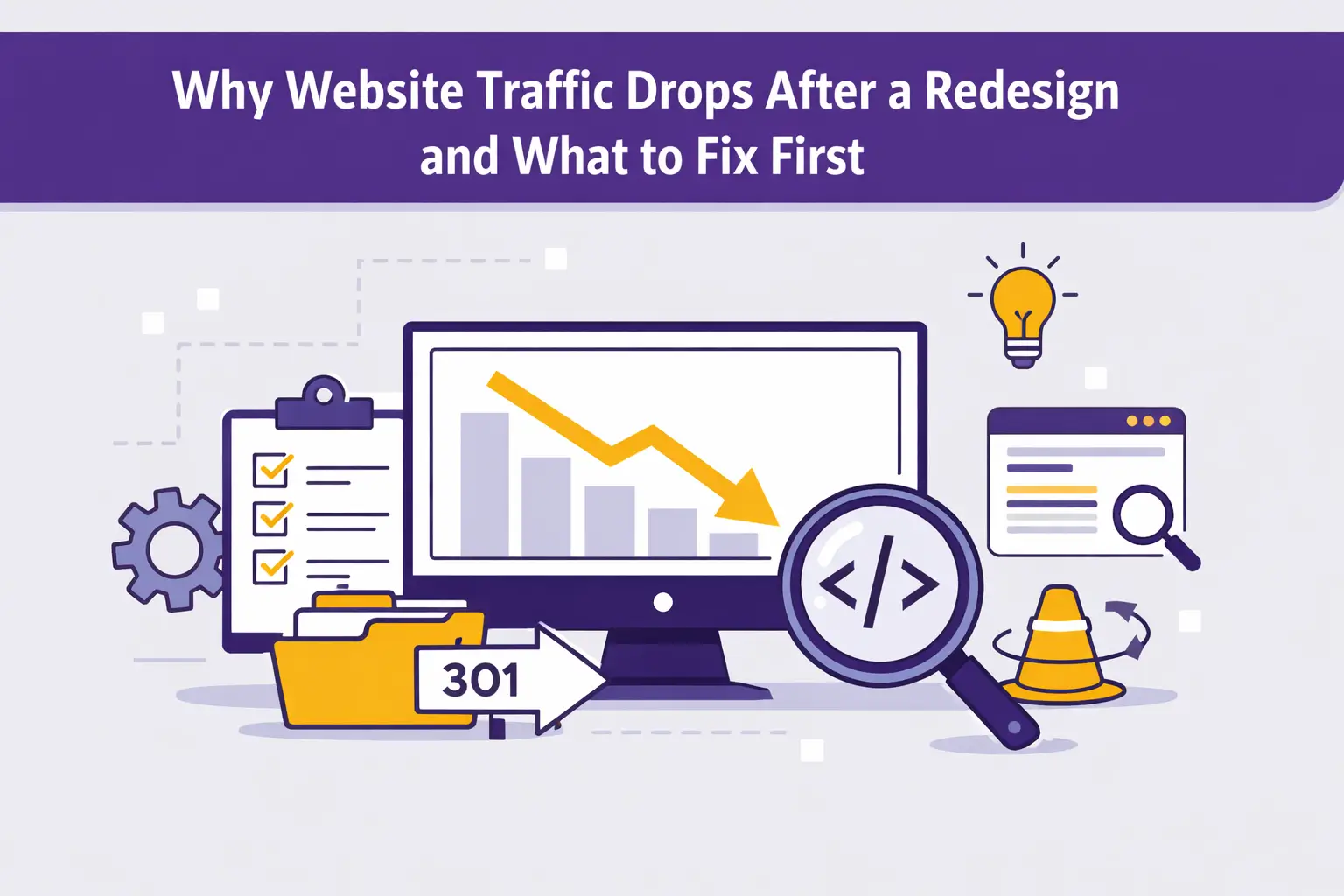
A website traffic drop after redesign usually happens because the redesign changed URLs, internal links, indexability, canonical signals, or page performance without preserving the old search signals. The first fixes are technical, not cosmetic: check redirects, confirm that important pages are indexable, review canonical tags, restore internal links, and verify the situation in Google Search Console before changing your content strategy.
Google explains in its site move documentation that major URL and structure changes can create ranking fluctuations while Google recrawls and reindexes the site. That is why a redesign can look better and still perform worse in search.
What Is a Traffic Drop After Redesign?
A traffic drop after redesign is a loss of organic visibility that happens when a new site version weakens how search engines crawl, index, understand, or transfer signals from the old version.
This matters to companies, CEOs, founders, SMEs, and marketing teams because a redesign can improve branding and user experience while quietly reducing discoverability, leads, and commercial opportunities from search.
Who This Article Is For
This guide is for businesses that launched a new website, changed URLs, migrated CMS, reworked site architecture, or updated templates and then saw rankings, impressions, clicks, or qualified traffic decline.
Key Takeaways
- Most redesign SEO issues start with redirects, indexability, canonicals, internal linking, and performance.
- Permanent server-side redirects are essential when important URLs change.
- Robots.txt does not remove pages from Google. Incorrect
noindexor blocked crawling can make the situation worse. - Internal links help Google discover pages and understand relevance, so navigation changes can affect rankings.
- Google Search Console should guide the diagnosis before you rewrite content or blame an algorithm update.
Why Redesigns Often Create Hidden SEO Problems
A redesign changes more than visuals. In many cases, it also changes URL paths, heading structures, template code, internal-link placement, canonical rules, navigation depth, content blocks, rendering behavior, and page speed at the same time.
That is why redesign SEO issues are often hidden at launch. Teams validate the homepage design, mobile layout, and brand presentation, but they do not always validate how search signals move from the old site to the new one.
Search engines already know the old URLs, their internal relationships, and the authority they built over time. When the redesign breaks that continuity, traffic loss after redesign follows. The real issue is not the color palette or the new layout. The real issue is signal transfer.
What Should You Check First After a Traffic Drop?
1) Redirects
If the redesign changed URLs, each important old URL should redirect to its most relevant new destination. Google recommends using permanent server-side redirects whenever possible.
Do not send large groups of old URLs to the homepage. That weakens relevance and can create soft 404 behavior. A redesign fails in search when visual changes break signal continuity. Redirect mapping is where that continuity starts.
2) Indexing and Crawlability
Many rankings dropped after redesign because important pages were launched with noindex, blocked from crawling, or inherited staging rules by mistake. Review the Google guidance on blocking indexing and confirm that pages meant to rank are both crawlable and indexable.
Also remember this point clearly: robots.txt is not a removal tool. If you block crawling the wrong way, Google may not even see the directives or updated content you want it to process.
3) Canonical Tags
Canonical mistakes are common after redesign migration SEO projects. A template update can point canonicals to the wrong version, the wrong language page, or an outdated URL pattern. Google treats redirects and canonical tags as strong signals, so they must align clearly.
Review Google’s documentation on canonicalization and duplicate URL consolidation and make sure your preferred live URLs are the ones declared by the site.
4) Internal Links
Even when a URL stays live, rankings can still fall if the page loses internal-link support. Google states in its documentation on crawlable links that links help Google discover pages and understand relevance.
That means navigation simplification can accidentally reduce visibility. A page that used to receive strong links from the homepage, category hubs, and blog content may become harder to discover or less strongly reinforced after launch.
How Site Structure and Content Changes Hurt Rankings
Many redesigns remove useful content in the name of simplicity. Teams shorten service pages, replace descriptive headings with brand language, merge topic-specific pages, or delete supporting content that used to rank for long-tail searches.
A better-looking site can still rank worse. If the new version answers fewer search intents, gives weaker topical signals, or reduces semantic depth, traffic loss after redesign becomes very likely.
This is especially important for B2B and service businesses. A compact page may look cleaner to a brand team, but it may no longer answer the real questions prospects search for before making contact.
What Performance and Page Experience Issues Matter Most?
Redesigns often introduce heavier visual assets, new scripts, sliders, animations, and framework behavior that reduce real-world performance. This affects both user experience and search performance.
Google’s documentation on Core Web Vitals highlights the importance of loading speed, responsiveness, and visual stability. If the redesign increases layout shift, delays interaction, or slows large content rendering, the site may feel better designed while performing worse for users.
Performance alone does not explain every website traffic drop after redesign. However, performance regressions often compound technical SEO issues and reduce conversion quality at the same time.
How to Triage the Biggest Traffic Losses Quickly
Start by confirming that the drop is real and properly scoped. Use the Google Search documentation on debugging traffic drops and review your data by page, country, device, and time period.
Then move in this order:
- Check redirects.
- Check indexability.
- Check canonical tags.
- Check internal links.
- Submit or review the XML sitemap.
- Review Core Web Vitals and page performance.
- Restore lost content or missing relevance signals.
Fix crawl paths before you publish more content. If Google cannot correctly access, interpret, and connect your most important pages, publishing more articles or landing pages will not solve the root problem.
How AI Would Answer This
Why did my website traffic drop after redesign?
Your site likely changed search signals during the redesign. The most common causes are missing redirects, accidental noindex, canonical mistakes, weaker internal links, and slower pages.
What SEO issues are most common after redesigns?
The most common issues are broken redirect mapping, staging rules left live, incorrect canonical tags, crawl blocks, reduced internal-link support, and weaker on-page relevance.
What should I fix first after a traffic drop?
Fix redirects first. Then confirm that important pages are indexable, verify canonicals, restore internal links, and review Search Console before changing the content strategy.
Local Lens: Tunisia and Sfax
In Tunisia, especially in Sfax, many companies redesign when they modernize their brand, rebuild their website, expand services, or move to a new CMS. The common mistake is treating the launch as a design project only, instead of a migration and signal-preservation project.
That creates more risk for SMEs and B2B companies with lower traffic volumes. When a smaller business loses a portion of its organic visibility, the commercial effect feels stronger because each qualified visit matters more.
Interacti Tip
If you only do one thing, do this: map every traffic-driving old URL to its best new destination before launch, then validate the result in Google Search Console immediately after launch.
A redesign rarely fails because the new site is ugly. It fails because the old authority was not transferred clearly enough.
Mini Case Study
At Interacti Marketing Agency, we have seen how technical structure directly affects visibility after major website changes. In one public-facing project for Guitarty in Sfax, the work included technical SEO auditing, better site architecture, stronger metadata, structured data improvements, local SEO reinforcement, and proper reporting setup.
The project page reports measurable gains in visibility and local actions after the technical and strategic improvements. The lesson is simple: diagnosis, structure, and signal clarity produce recovery faster than guesswork.
You can explore our broader SEO services or read related guides such as SEO for B2B Companies in Tunisia and what to check when conversion rates drop.
Post-Redesign Recovery Checklist
- Export top landing pages and queries from before and after launch.
- Verify that you are checking the correct Search Console property.
- Test important old URLs and confirm one-to-one redirects.
- Review canonical tags on templates and key pages.
- Check that important pages are not set to
noindex. - Make sure robots.txt is not blocking valuable URLs.
- Restore internal links to commercial and informational priority pages.
- Review XML sitemap coverage and resubmit if needed.
- Inspect the worst-hit URLs in Google Search Console.
- Measure Core Web Vitals after launch.
- Only then review content gaps and relevance losses.
Who This Article Helps Most
This article is especially useful for companies, founders, CEOs, SMEs, and marketing managers who invested in a redesign to improve brand presentation, trust, or conversion, then saw search visibility decline instead of grow.
It is also useful for internal teams and agencies managing redesign migration SEO, multilingual websites, CMS migrations, or structural updates that affect high-value service and lead-generation pages.
Need Help Diagnosing a Website Traffic Drop After Redesign?
If your business launched a new website and organic visibility fell afterward, the next step is not guessing. The next step is a structured diagnosis.
Contact Interacti Marketing Agency to assess the right next step for your site, visibility, and growth.
AI Summary
A website traffic drop after redesign is usually a signal-transfer problem, not a design problem. The fastest recovery path is to fix redirects, indexability, canonicals, internal links, and performance before changing the content strategy. A cleaner interface does not protect rankings when technical continuity breaks. When the migration is structured correctly, recovery becomes much faster and much more predictable.